
Are there consequences to shortcutting the Technology Adoption Cycle?
AI is here to stay. It’s the genie that won’t go back into the bottle.
But, is it a good or bad technology? Maybe that’s the wrong question.
The better question: Why is AI being adopted differently than every other technology in history? What does that tell us where this ends?
How technology adoption actually works
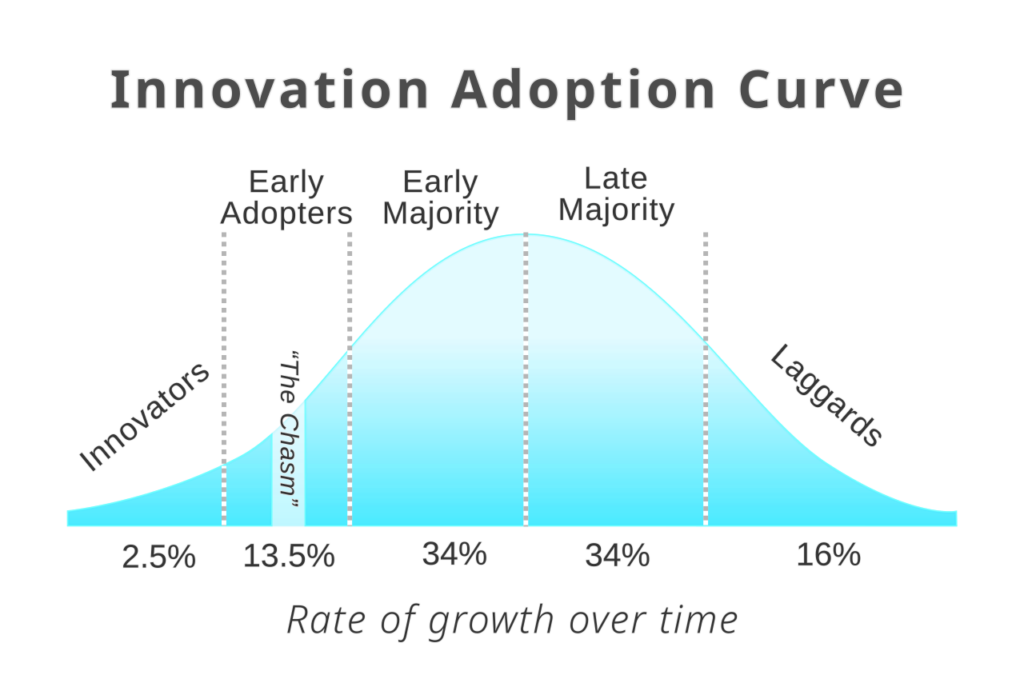
In sociology, the technology adoption cycle is a classic bell curve model.
Innovators (2.5%) → Early Adopters (13.5%) → Early Majority (34%) → Late Majority (34%) → Laggards (16%)
Innovators are the inventors and their network of peers. Early Adopters are typically technology enthusiasts and business professionals. The Early Majority are typically non-business consumers. Of course, not everyone starts at the beginning of the cycle. Jumping in at the Late Majority stage can feel like being an Early Adopter, especially if the technology advances to a new generation of features. This often depends on a person’s age and any exposure they’ve had with technology. There’s a compounding effect which allows people to jump into the cycle at any point, benefiting from all previous advancements. Laggards will be ignored in this discussion.
What’s missing from this model is time. How long does it take for technology to be adopted by 84% of the majority? Let’s look at recent history with mobile phones.
The first mobile phone was invented in 1973. It became commercially available with the 1G network in 1983. By 1991, 2G networks were launched, which caused a boom in usage throughout the 1990s. 3G phones hit in 2001. 4G networks started around 2010, and since 2019, we have 5G phones. Every 10 years, mobile phones upgrade their networks to a new generation and devices upgrade with new features.
Viewing this via the technology adoption cycle by adding time:
Innovators (1973-1983) → Early Adopters (1980s) → Early Majority (1990s) → Late Majority (2000s)
We can look at the math a few ways:
2010 – 1973 = 37 years (from invention forward)
2010 – 1983 = 27 years (from commercial availability forward)
That’s approximately 30-40 years to get 84% of people to adopt this technology!
Toward the end of this cycle for mobile phones came the modern smartphone. This represented a major shift in phone evolution and a start of a new technology cycle.
The first smartphones were released between 1992-1994. Basically, anything more than phone call ability. By the end of the 1990s, you had phone/PDA hybrids. You can already see a shortened adoption cycle.
BlackBerry’s became popular from 1999-2007. Then 2007 happened. The big shift to modern smartphones via the iPhone, followed by 2008 with Android.
Innovators (1992) → Early Adopters (1996-2007) → Early Majority (2007+) → Late Majority (2012+)
A 20 year adoption cycle, which represents a 10-20 year time reduction or 25-45% time improvement! A shorter cycle, still measured in decades, compounding knowledge from previous work, following a natural evolution curve. While I chose mobile phones, you can apply this to computers, the Internet, any other form of technology.
AI breaks every rule of technology adoption
These adoption cycles felt natural. Sure, there were marketing efforts behind them, but there tended to be a pull versus a push mechanism involved. Companies were willing to wait for consumers to come to them (pull) instead of forcing the technology onto consumers (push). Innovators kept improving on their technology to help entice consumers. Innovators were relying on early adopters to spread the benefits to their social circles, which pulled in more consumers.
AI is different. We all see it. We all feel it. The good and the bad.
November 2022: ChatGPT was released. It showed what was possible with current AI capabilities. This should have put society into the Early Adopters phase.
But that’s not what’s happening. The AI innovators are not waiting to pull the Early Adopters, the Early Majority, or the Late Majority into this technology. They are pushing the technology onto everyone regardless of want or desire. They are attempting to shortcut 10-15 years of mainstream adoption.
“Use AI or else!”
“If you don’t use AI, you’ll be left behind.”
“AI makes us more efficient, so we don’t need as many employees.”
Corporate sees this as marketing. People see these as threats. Threats create fear. Fear loses trust.
Why it’s happening
Money. Control. Competition. Investor pressure. It’s an arms race.
The OR style thinking at corporate scale: Replace OR augment. Speed OR accuracy. Cost reduction OR capability building. Technology OR people.
This creates an economic hype cycle! Billions of dollars invested with an expectation of immediate ROI! Today. Tomorrow. NOW! Not in a decade. Definitely not in two!
This creates corporate FOMO.
“We can’t wait for the market to come to us. Our competitors aren’t waiting.”
“We need to spend money to make money.”
“We don’t want to make the same mistakes we made in the past by missing out on a technology shift.”
This is not how the technology adoption cycle has ever worked!
What happens when you skip the natural adoption cycle
You lose trust.
Technology adoption historically augments human capability before it replaces it. That augmentation phase is where trust is built. Users experience the technology as helpful. They become advocates and influencers. They pull others in, naturally.
Skip augmentation → lose trust → lose organic adoption. Result? Forced adoption.
Forced adoption creates:
- Backlash, resentment from workers being replaced
- Resistance from users being coerced instead of enthusiasm
- Brittle systems built on AI that can’t yet do what the humans did
- A skills crisis as the people who understood the craft — deeply —- are pushed out before AI can replace what they actually do.
The public backlash is predictable if you understand psychology.
Forced adoption leads to hype cycles:
- Investor pressure compresses timelines
- Companies skip validation to show ROI
- Employee layoffs become en vogue in order to pay for AI investments
Hype creates a financial bubble.
The bubble
We’ve seen technology bubbles before. They’re fragile and unsustainable. They all have a similar shape.
Over-claiming → over-investment → over-valuation → reality correction → crash → recovery at sustainable level.
Dot-com era: the internet was real. The valuations weren’t. Dot-com busted and took years to recover.
IoT, crypto, metaverse… all had promises as hype and speculation that didn’t pan out.
AI era: the technology is real. The replacement claims aren’t. AI relies on human knowledge and intervention.
The difference between a technology that transforms an industry and a bubble that collapses is whether trust was built before scale was forced.
The Outcome. Don’t skip trust. Don’t force adoption.
Innovation requires passion and skills, which leads to deeply understanding the craft.
Craft → Structure
Structure → Trust
Trust → Adoption
Adoption → Value
Skip any step and the whole thing collapses.
AI companies are trying to go directly from craft to value — skipping structure, trust, and organic adoption entirely.
It won’t work. It never has. The hype fades. The bubbles pop. Investments lost. We’ve seen it before. History finds a way to repeat when people forget the lessons of the past. Today’s lessons will be more expensive.
The lesson? Innovation and adoption should be intentional.